











EduAdmin
Training Management System

Create, schedule, sell and deliver training with one feature-complete Training Management System and LMS

Effortless course scheduling

Set up courses in minutes, automate communication, and oversee the complete learning journey across in-person, online, and blended training in one unified platform.

Simplify registrations and payments

Automate the entire registration process with customisable forms, flexible payment options, and built-in invoicing.
Spend less time on administration and more time delivering great training.

Offer a seamless booking experience on your website

Give your customers a streamlined and professional way to discover and book your courses online. EduAdmin’s booking portal lets you showcase courses, handle registrations, and manage participants in one smooth, branded booking experience.

Create e-learning courses with ease

Create your own e-learning courses with our built-in content creator. 
Upload your videos, presentations and e-learning packages (SCORM and others), or create your own quizzes, digital exams, HTML pages, and much more.

Manage both online training and instructor-led classroom courses in a single system, or combine them for a seamless blended learning experience.

Designed to fit into your digital ecosystem

EduAdmin integrates seamlessly with the tools you already use - from accounting and payment systems to marketing platforms and virtual classrooms. Our ready-made integrations ensure smooth data flows and reduce manual administration across your organisation. Need something more tailored? Our accessible and well-documented API makes it easy to build your own integrations and extend EduAdmin to suit your exact requirements.

Appreciated daily by thousands of users

A system tailored to your industry

EduAdmin is a powerful training management system for training providers across many different industries. Below you will find industry-specific solutions.

Construction, Road Work, CDM and Manufacturing

Fire, Rescue and Safety

Leadership & Management CPD Training Providers

Driver CPC & Safe Driving

The system ensures that the right people have the correct valid certificates. You benefit from smooth certificate management and easy follow-up of authorisations in accordance with industry requirements.

EduAdmin supports both theoretical e-learning and practical classroom training, which is particularly suitable for safety and rescue courses where theory is often combined with practical sessions.

EduAdmin manages the entire process for your leadership and management CPD training: participant registration, course booking, documentation, attendance recording and course evaluation.

Whether you offer CPC continuing training, basic training for lorry and bus drivers, or other transport-related courses, EduAdmin provides you with the tools you need to efficiently administer the entire training workflow.

Case studies

Be a part of the success

EduAdmin supports hundreds of customers in growing and scaling their training business. By bringing everything together in one system, we help organisations save time, reduce complexity, and create better experiences for their learners.

With EduAdmin, you have everything you need to succeed – and we’re confident you will.

Frequently Asked
Questions

About
Training Management Software

What is a Training Management System?

Training management software (TMS) is a system that helps organisations plan, deliver, and manage instructor-led and virtual training programmes. It centralises course administration, scheduling, registration, instructor management, and reporting in one platform. Training management software is primarily used by corporate L&D teams and professional training providers to streamline training operations.

A training management system supports the full lifecycle of training administration - including course planning, session scheduling, online enrolment, participant communication, instructor coordination, resource allocation, budgeting, invoicing, and performance tracking. By replacing spreadsheets and manual processes with automated workflows, a TMS system improves efficiency, accuracy, and scalability.

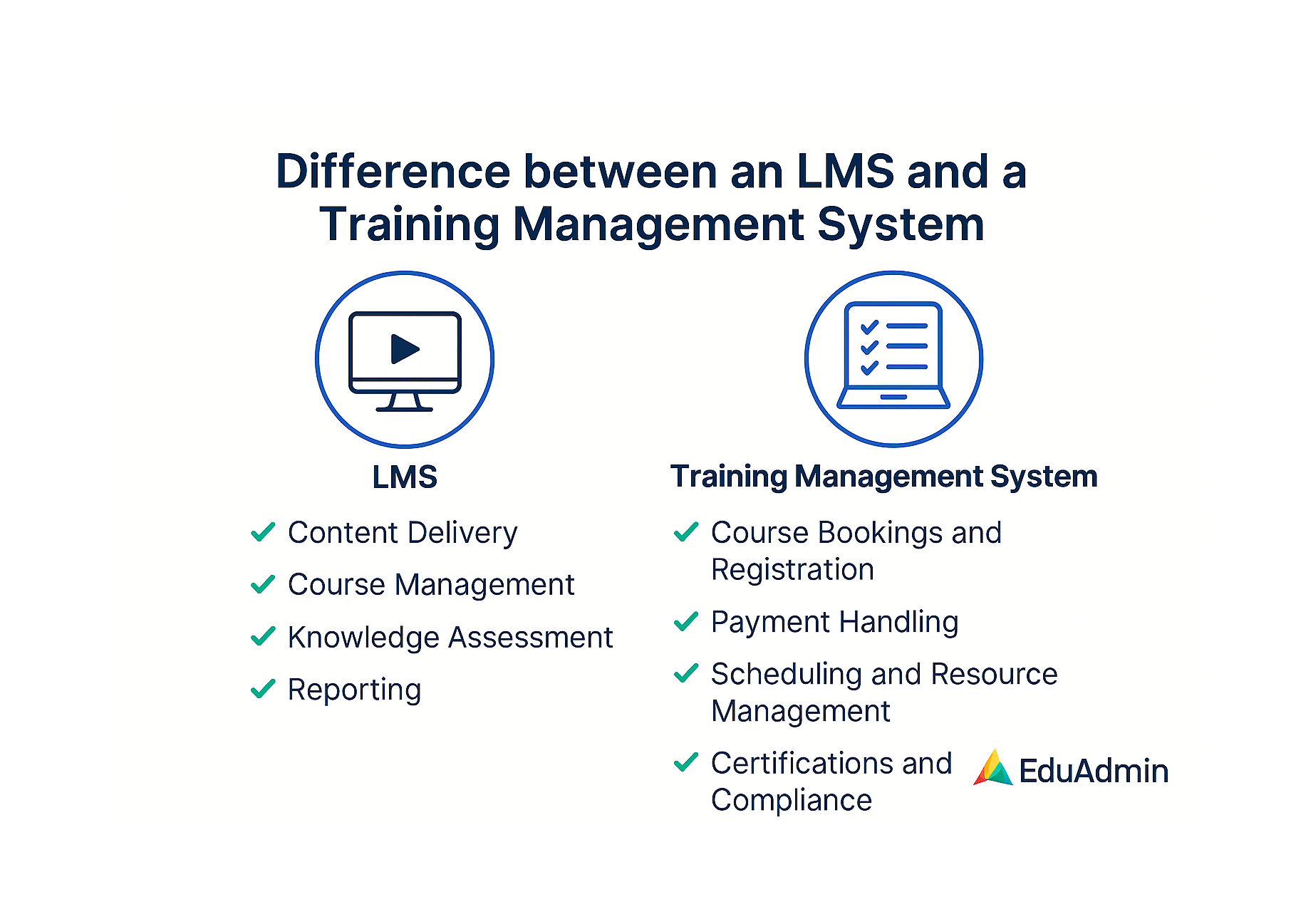
While a learning management system (LMS) focuses on delivering e-learning content, training management software is designed to manage the operational, logistical, and financial aspects of running training programmes. This makes it particularly valuable for organisations delivering instructor-led training (ILT), virtual instructor-led training (VILT), blended learning, and recurring certification programmes.

By using training management software, organisations gain better visibility into training performance, revenue, costs, and capacity - enabling smarter decisions and more effective learning operations.

Who uses a Training Management System?

A Training Management System (TMS) is used by organisations that plan, deliver, and manage instructor-led or structured training programmes. This includes commercial training providers, corporate L&D teams, internal training departments, and professional education organisations that need to streamline training administration and operations.

Training management software is particularly valuable for:

Commercial training providers
Organisations that sell courses to external customers and deliver public (open) and private (in-house) training sessions. A TMS helps manage course scheduling, online registration, customer communication, invoicing, resource planning, and profitability tracking.

Corporate L&D and internal training teams
Companies that provide employee training, onboarding, compliance training, certification programmes, and upskilling initiatives. A training management system supports session planning, enrolment management, instructor coordination, reporting, and compliance tracking.

Blended learning providers
Training organisations delivering a mix of face-to-face training, virtual instructor-led training (VILT), and e-learning. A TMS enables them to manage complex training programmes that combine multiple learning formats into one structured offering.

Professional education and certification bodies
Associations, academies, and industry organisations that run recurring courses, qualification programmes, or continuing professional development (CPD) training.

Overall, any organisation that delivers recurring, instructor-led, or structured training programmes - and needs better control over scheduling, administration, resources, and reporting - can benefit from a Training Management System.

Do I need a training management system?

You may need a training management system if you regularly deliver instructor-led, virtual, or blended training programmes and rely on manual processes to manage them. If your team spends significant time on scheduling, enrolment, invoicing, reporting, and administrative coordination, a TMS can help streamline and automate these tasks.

Many training providers and corporate L&D teams reach a point where spreadsheets, email threads, and disconnected systems become difficult to manage. Common signs that you may benefit from training management software include:

  • Re-entering the same data across multiple systems

  • Spending hours scheduling courses and assigning instructors

  • Manually generating invoices and financial reports

  • Struggling to track attendance, compliance, or certification status

  • Experiencing errors caused by manual administration

  • Lacking clear visibility into course profitability or resource capacity

A training management system centralises your training operations in one platform, helping to reduce administrative workload, minimise human error, and improve operational efficiency. Instead of spending time on repetitive manual tasks, your team can focus on improving learning experiences, expanding course offerings, and growing your training programmes.

Ultimately, if your training administration feels time-consuming, fragmented, or difficult to scale, it is likely time to consider a training management system.

Can a TMS run my training business?

Yes! A Training Management System (TMS) can act as the central platform for running and scaling your training business. It brings together course management, administration, finance, resource planning, and reporting into one integrated system.

With a modern, cloud-based training management system like EduAdmin, you can manage your entire training operation from a single hub. This includes course scheduling, online registration, instructor coordination, venue and resource management, invoicing, budgeting, and performance tracking. Instead of using multiple disconnected tools, a TMS centralises your training data and processes in one secure platform accessible from anywhere.

Many training providers also use their TMS to support business growth. Features such as CRM functionality, lead management, automated communication, marketing integrations, and analytics help you track enquiries, monitor conversion rates, measure return on investment, and identify opportunities to expand your training programmes.

While a TMS will not replace your overall business strategy, it provides the operational foundation needed to run your training company efficiently, profitably, and at scale.

What’s the difference between a TMS and an LMS?

The main difference between a Training Management System (TMS) and a Learning Management System (LMS) is their focus. A TMS is designed to manage the operational and administrative side of training, while an LMS is built to deliver and track online learning content.

A Training Management System supports the full administration of instructor-led training (ILT), virtual instructor-led training (VILT), and structured training programmes. It manages course scheduling, online enrolment, instructor coordination, venue and resource planning, invoicing, budgeting, CRM, and reporting. In short, a TMS helps training providers and corporate L&D teams run the business and logistics of training.

A Learning Management System, on the other hand, is primarily focused on delivering digital learning. An LMS hosts e-learning courses, enables self-paced online training, tracks learner progress, and manages assessments and certifications in an online environment.

Many organisations use both systems together, either by integrating a TMS and an LMS, or by using a TMS like EduAdmin that has a built-in LMS, which provides a complete training ecosystem. This allows you to deliver and track e-learning courses alongside instructor-led and blended training programmes - all from a single platform.

In summary, a TMS manages training operations, an LMS manages online learning delivery, and EduAdmin provides the best of both worlds by combining these capabilities in one integrated system.

What are the advantages of a training management system?

A Training Management System (TMS), also referred to as training management software, offers numerous benefits for organisations managing instructor-led, virtual, or blended learning programmes. By centralising training administration and automating routine tasks, a TMS streamlines training operations, reduces manual workload, and improves overall learning programme efficiency.

The main advantages of using a TMS include:

  • Operational efficiency: Automating scheduling, enrolments, communications, and reporting reduces repetitive tasks and human error across your training operations.
  • Enhanced visibility and control: A TMS provides a centralised overview of courses, instructors, resources, budgets, and revenue, helping training managers make informed decisions.
  • Financial and commercial benefits: With automated invoicing, cost tracking, and profitability reporting, a TMS supports commercial training management and ensures training programmes are financially sustainable.
  • Improved learner and instructor experience: Centralised course information, automated reminders, and easy access to materials improve engagement, satisfaction, and overall learning outcomes.
  • Scalability and growth: Freeing up administrative time enables training providers to expand course offerings, reach new audiences, and optimise programme delivery.
  • Competitive advantage: Organisations using a TMS can respond faster to market demand, maintain high service standards, and gain a stronger position in the commercial training sector.

To summarise, a Training Management System not only simplifies the administrative and operational aspects of running a training business but also provides a strategic foundation for growth, improved learning programme efficiency, and stronger commercial performance.

What are the key features of a TMS?

A Training Management System (TMS) provides a wide range of features designed to streamline training operations, improve efficiency, and enhance the learner and instructor experience. Key features commonly found in a TMS include:

  • Course management: Plan, schedule, and manage instructor-led, virtual instructor-led, and blended learning programmes in one central platform.
  • Online registration and enrolment: Enable learners to register online, automate confirmations, and reduce administrative workload.
  • Instructor and resource management: Assign trainers, allocate rooms or virtual resources, and manage availability across multiple sessions.
  • Finance and invoicing: Track costs, manage budgets, generate invoices, and monitor revenue and profitability.
  • Reporting and analytics: Gain insights into course attendance, learner progress, financial performance, and overall training effectiveness.
  • Certification and compliance tracking: Maintain certification validity, track compliance, and ensure learners meet required standards.
  • CRM and contact management: Manage learner and client information, communication history, and engagement across courses.
  • Marketing and communications: Send automated emails, newsletters, and course reminders; integrate with websites and campaigns to attract new learners.
  • Customer or learner portals: Provide learners with self-service access to course information, schedules, materials, and progress tracking.
  • Blended learning support: Combine face-to-face, virtual, and e-learning delivery in a single programme.
  • Integrations: Connect with external systems such as accounting software, payment gateways, or other learning platforms.
  • Customisation and scalability: Tailor workflows, branding, and reporting to suit the needs of different organisations and scale operations as the business grows.

In conclusion, a TMS is more than just a scheduling tool - it is a comprehensive training administration system that centralises operations, automates routine tasks, and provides the insight and control needed to run a successful training business efficiently.

What's new?

Read our news and blog posts