
In today’s digital world, education is no longer an isolated activity – it is a strategic part of business development. Companies, educational institutions, and organizations invest billions in skills development to meet rapid changes, new regulations, and increased demands for flexibility. But here arises a critical question: Is a Learning Management System (LMS) enough?
The answer is no. An LMS is a tool for delivering and tracking learning, but it is not built to handle the complex administration surrounding courses, participants, payments, certifications, and reporting. This is where a Training Management System (TMS) comes into play – a solution that not only complements LMS but takes the entire education process to the next level.
Difference Between LMS and Training Management System
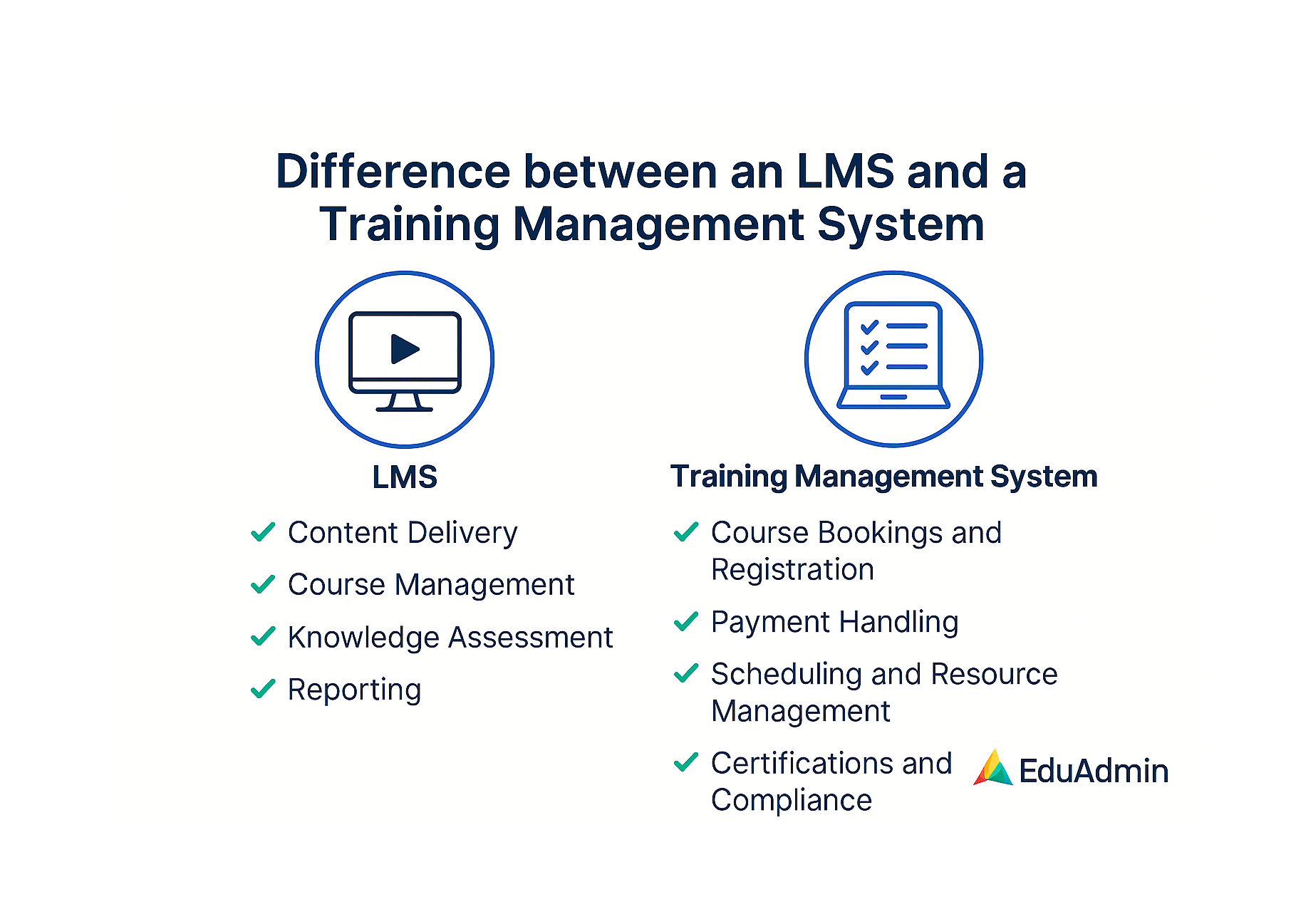
An LMS primarily serves as a platform for distributing digital content, tracking learning, and measuring results. It is perfect for e-learning, internal training, and competency paths. But when we talk about course administration – everything from scheduling, registration, payment, invoicing, communication with participants, to managing physical locations and resources – a LMS is very limited.
The Training Management System, on the other hand, is designed to manage the entire lifecycle of a course:
- Registration and booking – automated flows for participants.
- Payment and invoicing – integrated with accounting and CRM systems.
- Resource management – venues, instructors, materials.
- Reporting and compliance – meets legal requirements and internal policies.
- Communication – automated reminders, confirmations, and follow-ups.
In other words: LMS is the engine for learning. TMS is the hub for the entire education operation.
Challenges of Using Only LMS
Relying solely on an LMS can create significant problems:
- Manual administration – registrations, payments, and scheduling often occur outside the LMS, leading to double work.
- Lack of integration – LMS is rarely connected to CRM or accounting systems, causing data silos.
- Compliance difficulties – many industries require detailed documentation and reporting that LMS cannot handle.
- Poor user experience – participants often need to navigate multiple systems to register, pay, and get course information.
- Limited scalability – as the business grows, the LMS quickly becomes a bottleneck.
Benefits of a Training Management System
Here’s why a TMS is a game-changer:
1. Automation saves time and money
With a Training Management System, you can automate the entire chain – from registration to invoicing. This reduces manual handling, frees up time for strategic work, and lowers the risk of errors.
2. Professional user experience
A smooth registration process, easy payment, and clear communication create a positive experience that strengthens the brand.
3. Full control and insights
A Training Management System provides you with real-time data on participants, revenue, course status, and resource utilisation. This enables data-driven decision-making.
4. Integration with business systems
Connect your Training Management System to HR, CRM, and financial systems – and create a seamless flow of information. This provides better control and reduces duplicate work.
5. Scalability for growth
Whether you manage 50 or 50,000 participants, a Training Management System is designed to grow with your business.
Business Value and ROI
Investing in a Training Management System is not just a cost – it is a strategic investment with clear returns:
- Reduced administrative costs – up to 70% less manual handling.
- Increased revenue security – automated invoicing and payments reduce lost income.
- Better compliance – reduces the risk of fines and legal issues.
- Higher customer satisfaction – smooth processes lead to more repeat customers.
Future Outlook
Digitalization and AI are rapidly changing the education industry. A modern TMS has AI tools to:
- Predict course demand.
- Create course content, exams, and quizzes.
- Automate customer communication.
- Optimize resource planning.
The future is about smart administration – and that is something an LMS can never deliver on its own.
Summary
An LMS is essential – but it is only part of the puzzle. To create an efficient, scalable, and profitable education operation, you need a Training Management System that manages the entire process. That is the difference between surviving and thriving.
What is the next step? Invest in a training management system and unlock the potential of your training business.