Run your entire training business on one platform

A Training Management System (TMS) helps training providers, corporate L&D teams, and professional education organisations centralise and automate the administration of training.

From scheduling courses and managing registrations to tracking certifications and delivering e-learning, a unified system allows you to scale your operations without increasing administrative overhead.

Running training shouldn't feel like a juggling act

Most training providers spend more time fighting their tools than delivering great training. 


Spreadsheet chaos

Participant data scattered across multiple spreadsheets.
No one knows which version is correct. 

Endless manual follow-up 

Chasing payments, sending reminders, updating registers — every single day. 

No visibility 

No clear view of course profitability,
trainer availability, or expiring certifications. 

How a TMS can streamline your operations

Here’s how EduAdmin replaces manual work, scattered systems, and uncertainty with structure, automation, and control.

One system instead of disconnected tools

Stop copying participant data between spreadsheets, calendars, email tools, and payment systems. A TMS brings everything together — scheduling, bookings, payments, communication, and reporting — so your data stays accurate and your workflows run smoothly.

No more double-booked trainers or venues

Real-time availability gives you full visibility and flags conflicts before they happen. See exactly who’s teaching what, where, and when — and keep your schedule running without costly mistakes

Get paid at the point of booking — not 60 days later

Integrated Stripe and PayPal payments let participants pay when they book. Automatic invoicing handles B2B clients, so you get paid faster without chasing invoices or reconciling payments manually.

Show-up rates up, no-shows down

Automated SMS and email reminders keep participants informed at every stage — from booking confirmation to final reminders before the session. The result: better attendance, better preparation, and fewer empty seats.

Compliance proven in 30 seconds, not 3 days

Need to show certification status? Generate a compliance report instantly. Automated expiry alerts help you fix gaps before they become a problem — not after. 

Open a new location without the admin headache

Add trainers, venues, and courses in new cities without buying new software licenses or hiring more admin staff. The same TMS scales from one location to ten — without adding complexity.

One platform for the full training lifecycle

Plan, sell, deliver, and track — without switching between spreadsheets, 
calendars, and disconnected tools. 

Plan
Sell
Deliver
Track

Plan your training

Build courses, assign trainers, book venues, and manage capacity from one calendar. Create tasks and set automatic reminders for you and your colleagues. No more double-booked trainers or room conflicts.

Course Management
Plan sessions, assign trainers, book venues, manage capacity.
Task Management
Create tasks linked to your course templates and set automatic reminders.
LMS & E-learning
Build courses, upload SCORM, create quizzes.
Plan
Sell
Deliver
Track

Sell your training

Make it easy for participants to find, book, and pay for your courses. With a flexible booking portal, customisable registration forms, and integrated payment solutions, you can turn interest into confirmed bookings without manual follow-up.

Participant registration
Create course-specific forms to capture the right data.
Booking portal
Display courses with real-time availability and instant booking.
Invoicing & payments
Online payments and automatic invoicing.
Plan
Sell
Deliver
Track

Deliver your training

Run smooth training sessions with everything in one place. Give participants, instructors, and admins the tools they need to stay aligned — from course materials and attendance to evaluations and E-learning.

Participant portal
Access E-learning, course materials, and online sessions in one place.
Instructor Portal
View participant lists, manage attendance, start sessions and evaluations.
Virtual
Run virtual, on-site, or on-demand training from one platform.
Plan
Sell
Deliver
Track

Track your training

Stay in control of certifications, progress, and performance across all your training activities. Get full visibility into what’s been completed, what’s expiring, and how your training courses are performing.

Certificates
Issue certificates and certifications automatically after course completion.
Expiry alerts
Automatically notify participants when certifications expire
Progress & reporting
Track learner progress, and gain insights into course performance, popularity, and profitability

Why £279/month pays for itself

Most EduAdmin customers see a full return on investment within the first quarter


15+

hours saved per week

On admin tasks alone; scheduling, reminders, invoicing, and reporting. At £25/hour, that's £1,500/month in reclaimed time.

30%+

increase in bookings

Online booking portal and re-engagement campaigns to past delegates. For a £5K/month training business, that's £1,500+ in additional revenue.

£0.40

per delegate per month

At 500 active delegates on the Starter plan, EduAdmin costs less than 40p per delegate. Most training providers charge £50-£500+ per course.

What you get for £279/month

Replaces multiple tools: 

  • Standalone booking forms
  • Spreadsheets (£0 but costs hours) 
  • Calendar software (£6-15/month) 
  • Email marketing tool (£20-100/month) 
  • LMS platform (£50-300/month) 
  • Payment processor fees (already integrated) 
  • Certificate generator (custom-built or manual) 

Potential savings: 
Replacing 4-6 separate tools with one platform typically saves £100-500/month in software costs alone.

Beyond software savings:
Most teams also save 15+ hours per week by reducing manual admin, spreadsheet work, and the use of disconnected tools. That’s time you can spend on delivering training and growing your business instead.

Manage Instructors and Resources Efficiently

Coordinate your team and resources without the guesswork. Easily assign instructors to courses, check availability in real time, and ensure the right person is booked for the right session.

Automated communications make it simple to send invitations and confirmations on time, keeping everyone informed and prepared. This reduces the risk of scheduling conflicts and improves the overall flow of your training operations.

Benefits of a built-in LMS System

  • Smoother administration – eliminate manual processes and Excel spreadsheets.
  • Increased learner engagement – through interactive elements and personalized learning journeys.
  • Scalability – grow with more users, more courses, and evolving business needs.
  • Cost-effectiveness – achieve more training with less effort and better control over licenses and resources.
  • Customizability – the platform can be tailored to your brand, requirements, and goals.

Instructor-Led Training (ILT) Software

Deliver Impactful Training with EduAdmin

Streamline, scale, and elevate your in-person and virtual training with EduAdmin’s Instructor-Led Training (ILT) software.
From scheduling and instructor coordination to learner engagement and performance tracking, everything you need to deliver exceptional training experiences is gathered in one intuitive platform.

Create and send email newsletters that generate more bookings

EduAdmin is fully integrated with the web service EditNews, making it easy to create newsletters and course invitations.

In EduAdmin you can effortlessly target the right group for your campaigns based on your customer database and previous course participants. Want to promote a follow-up course to those who’ve already completed the introduction? With just a few clicks, you can launch professional campaigns that lead to new bookings.

Designed to fit into your digital ecosystem

With 40+ ready-made integrations and an open API, EduAdmin integrates seamlessly with the tools you already use — from accounting and payment systems to marketing platforms and virtual classrooms.

Trusted by training teams worldwide 

High Performer
Case studies

Be a part of the success

EduAdmin supports hundreds of customers in growing and scaling their training business. By bringing everything together in one system, we help organisations save time, reduce complexity, and create better experiences for their learners.

With EduAdmin, you have everything you need to succeed — and we’re confident you will.

Helpful resources for training teams

If you want to know more about training management systems we recommend that you also read our guides below. 

See how EduAdmin compares to other TMSs

Head-to-head comparisons with the platforms training providers are switching 

Accessplanit

A training management system focused on backend administration for training operations and scheduling.

Administrate

Combines course mangement with sales, qouting and revenue tracking at enterprise global scale.

Arlo

Built for commercial training providers, with a strong focus on sales, marketing, and lead generation

Dante

A course administration and booking system designed to manage training schedules and registrations

Training Orchestra

Focused on complex resource planning, logistics, and large-scale instructor-led training operations.

Frequently Asked
Questions

About
Training Management Software

What is a Training Management System?

Training management software (TMS) is a system that helps organisations plan, deliver, and manage instructor-led and virtual training programmes. It centralises course administration, scheduling, registration, instructor management, and reporting in one platform. Training management software is primarily used by corporate L&D teams and professional training providers to streamline training operations.

A training management system supports the full lifecycle of training administration - including course planning, session scheduling, online enrolment, participant communication, instructor coordination, resource allocation, budgeting, invoicing, and performance tracking. By replacing spreadsheets and manual processes with automated workflows, a TMS system improves efficiency, accuracy, and scalability.

While a learning management system (LMS) focuses on delivering e-learning content, training management software is designed to manage the operational, logistical, and financial aspects of running training programmes. This makes it particularly valuable for organisations delivering instructor-led training (ILT), virtual instructor-led training (VILT), blended learning, and recurring certification programmes.

By using training management software, organisations gain better visibility into training performance, revenue, costs, and capacity - enabling smarter decisions and more effective learning operations.

Who uses a Training Management System?

A Training Management System (TMS) is used by organisations that plan, deliver, and manage instructor-led or structured training programmes. This includes commercial training providers, corporate L&D teams, internal training departments, and professional education organisations that need to streamline training administration and operations.

Training management software is particularly valuable for:

Commercial training providers
Organisations that sell courses to external customers and deliver public (open) and private (in-house) training sessions. A TMS helps manage course scheduling, online registration, customer communication, invoicing, resource planning, and profitability tracking.

Corporate L&D and internal training teams
Companies that provide employee training, onboarding, compliance training, certification programmes, and upskilling initiatives. A training management system supports session planning, enrolment management, instructor coordination, reporting, and compliance tracking.

Blended learning providers
Training organisations delivering a mix of face-to-face training, virtual instructor-led training (VILT), and e-learning. A TMS enables them to manage complex training programmes that combine multiple learning formats into one structured offering.

Professional education and certification bodies
Associations, academies, and industry organisations that run recurring courses, qualification programmes, or continuing professional development (CPD) training.

Overall, any organisation that delivers recurring, instructor-led, or structured training programmes - and needs better control over scheduling, administration, resources, and reporting - can benefit from a Training Management System.

Do I need a training management system?

You may need a training management system if you regularly deliver instructor-led, virtual, or blended training programmes and rely on manual processes to manage them. If your team spends significant time on scheduling, enrolment, invoicing, reporting, and administrative coordination, a TMS can help streamline and automate these tasks.

Many training providers and corporate L&D teams reach a point where spreadsheets, email threads, and disconnected systems become difficult to manage. Common signs that you may benefit from training management software include:

  • Re-entering the same data across multiple systems

  • Spending hours scheduling courses and assigning instructors

  • Manually generating invoices and financial reports

  • Struggling to track attendance, compliance, or certification status

  • Experiencing errors caused by manual administration

  • Lacking clear visibility into course profitability or resource capacity

A training management system centralises your training operations in one platform, helping to reduce administrative workload, minimise human error, and improve operational efficiency. Instead of spending time on repetitive manual tasks, your team can focus on improving learning experiences, expanding course offerings, and growing your training programmes.

Ultimately, if your training administration feels time-consuming, fragmented, or difficult to scale, it is likely time to consider a training management system.

Can a TMS run my training business?

Yes! A Training Management System (TMS) can act as the central platform for running and scaling your training business. It brings together course management, administration, finance, resource planning, and reporting into one integrated system.

With a modern, cloud-based training management system like EduAdmin, you can manage your entire training operation from a single hub. This includes course scheduling, online registration, instructor coordination, venue and resource management, invoicing, budgeting, and performance tracking. Instead of using multiple disconnected tools, a TMS centralises your training data and processes in one secure platform accessible from anywhere.

Many training providers also use their TMS to support business growth. Features such as CRM functionality, lead management, automated communication, marketing integrations, and analytics help you track enquiries, monitor conversion rates, measure return on investment, and identify opportunities to expand your training programmes.

While a TMS will not replace your overall business strategy, it provides the operational foundation needed to run your training company efficiently, profitably, and at scale.

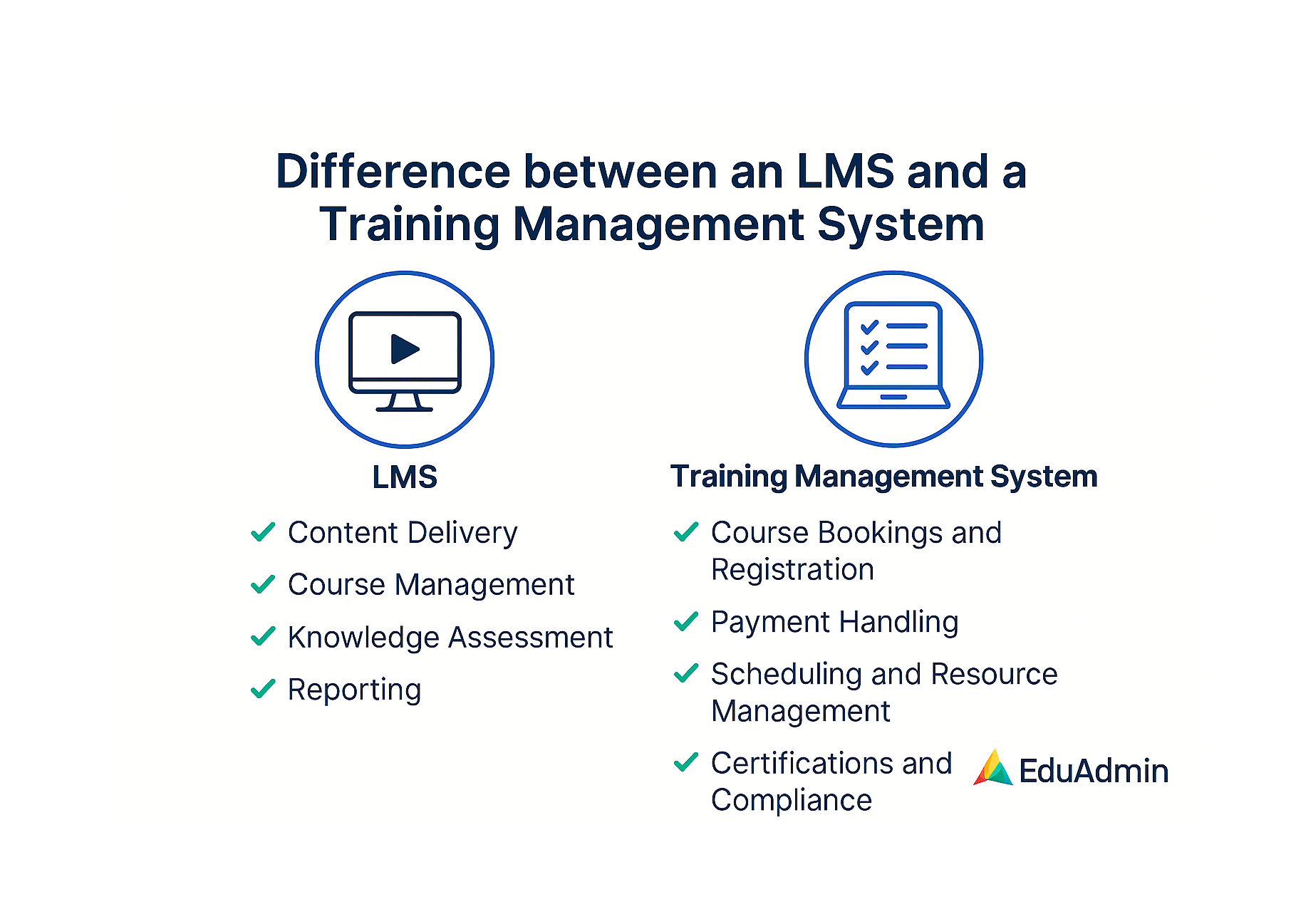
What’s the difference between a TMS and an LMS?

The main difference between a Training Management System (TMS) and a Learning Management System (LMS) is their focus. A TMS is designed to manage the operational and administrative side of training, while an LMS is built to deliver and track online learning content.

A Training Management System supports the full administration of instructor-led training (ILT), virtual instructor-led training (VILT), and structured training programmes. It manages course scheduling, online enrolment, instructor coordination, venue and resource planning, invoicing, budgeting, CRM, and reporting. In short, a TMS helps training providers and corporate L&D teams run the business and logistics of training.

A Learning Management System, on the other hand, is primarily focused on delivering digital learning. An LMS hosts e-learning courses, enables self-paced online training, tracks learner progress, and manages assessments and certifications in an online environment.

Many organisations use both systems together, either by integrating a TMS and an LMS, or by using a TMS like EduAdmin that has a built-in LMS, which provides a complete training ecosystem. This allows you to deliver and track e-learning courses alongside instructor-led and blended training programmes - all from a single platform.

In summary, a TMS manages training operations, an LMS manages online learning delivery, and EduAdmin provides the best of both worlds by combining these capabilities in one integrated system.

What are the advantages of a training management system?

A Training Management System (TMS), also referred to as training management software, offers numerous benefits for organisations managing instructor-led, virtual, or blended learning programmes. By centralising training administration and automating routine tasks, a TMS streamlines training operations, reduces manual workload, and improves overall learning programme efficiency.

The main advantages of using a TMS include:

  • Operational efficiency: Automating scheduling, enrolments, communications, and reporting reduces repetitive tasks and human error across your training operations.
  • Enhanced visibility and control: A TMS provides a centralised overview of courses, instructors, resources, budgets, and revenue, helping training managers make informed decisions.
  • Financial and commercial benefits: With automated invoicing, cost tracking, and profitability reporting, a TMS supports commercial training management and ensures training programmes are financially sustainable.
  • Improved learner and instructor experience: Centralised course information, automated reminders, and easy access to materials improve engagement, satisfaction, and overall learning outcomes.
  • Scalability and growth: Freeing up administrative time enables training providers to expand course offerings, reach new audiences, and optimise programme delivery.
  • Competitive advantage: Organisations using a TMS can respond faster to market demand, maintain high service standards, and gain a stronger position in the commercial training sector.

To summarise, a Training Management System not only simplifies the administrative and operational aspects of running a training business but also provides a strategic foundation for growth, improved learning programme efficiency, and stronger commercial performance.

What are the key features of a TMS?

A Training Management System (TMS) provides a wide range of features designed to streamline training operations, improve efficiency, and enhance the learner and instructor experience. Key features commonly found in a TMS include:

  • Course management: Plan, schedule, and manage instructor-led, virtual instructor-led, and blended learning programmes in one central platform.
  • Online registration and enrolment: Enable learners to register online, automate confirmations, and reduce administrative workload.
  • Instructor and resource management: Assign trainers, allocate rooms or virtual resources, and manage availability across multiple sessions.
  • Finance and invoicing: Track costs, manage budgets, generate invoices, and monitor revenue and profitability.
  • Reporting and analytics: Gain insights into course attendance, learner progress, financial performance, and overall training effectiveness.
  • Certification and compliance tracking: Maintain certification validity, track compliance, and ensure learners meet required standards.
  • CRM and contact management: Manage learner and client information, communication history, and engagement across courses.
  • Marketing and communications: Send automated emails, newsletters, and course reminders; integrate with websites and campaigns to attract new learners.
  • Customer or learner portals: Provide learners with self-service access to course information, schedules, materials, and progress tracking.
  • Blended learning support: Combine face-to-face, virtual, and e-learning delivery in a single programme.
  • Integrations: Connect with external systems such as accounting software, payment gateways, or other learning platforms.
  • Customisation and scalability: Tailor workflows, branding, and reporting to suit the needs of different organisations and scale operations as the business grows.

In conclusion, a TMS is more than just a scheduling tool - it is a comprehensive training administration system that centralises operations, automates routine tasks, and provides the insight and control needed to run a successful training business efficiently.

Ready to simplify your training operation?

Join hundreds of training providers who replaced spreadsheet chaos with one powerful platform. 

Download our Whitepaper

Learn more about how you can work with EduAdmin